Feeds:
Posts
Comments

Image

JK Shin, CEO and president of Samsung’s mobile unit, unveiled GALAXY S4 in New York in March 2013.

TCO Development, a global sustainability certification agency of information technology, has launched a probe into its decision to accord sustainability certification to the GALAXY  S4, the flagship smartphone of Samsung Electronics Co., Ltd., the Stockholm-based agency said in a press release on June 5.

Greenwashing

TCO’s decision came one day after a joint call made by global sustainability and workplace safety advocates to rescind TCO Certified, the Swedish agency’s brand certification, for Samsung’s latest smartphone.  The GALAXY S4 is the first smartphone certified by TCO for sustainability.  “TCO’s action amounts to ‘greenwashing of the worst kind,’” said Sanjiv Pandita, executive director of Asia Monitor Resource Center in Hong Kong, in a press statement jointly released by SHARPS and twenty-four advocacy groups globally.

Corrective Action?

In the statement, the activists pointed to the ongoing blood disorder cluster at Samsung and the recent fatal chemical leaks at its semiconductor plant.  TCO said it would demand “corrective action of Samsung” if its probe concluded the activists’ accusations “can apply to” the GALAXY S4.

TCO appears unlikely to retract its certification of Samsung unless international pressure further intensifies.

Even with its own criteria for smartphone certification, TCO would find it hard to justify its certification of the GALAXY S4 or its response to the subsequent international criticism of the certification.  One criterion stipulates that the applicant for the certification comply with UN Convention on the Rights of the Child, Article 32.  A search of “Samsung” and “labor” on Google turns up literally hundreds of news articles and blog entries on Samsung’s recent use of child labor in China.

Image

Sören Enholm, CEO of TCO Development which accorded GALAXY S4 sustainability certification, despite Samsung’s ongoing labor and sustainability issues.

Samsung’s Glee Amid Its Terrible Sustainability Records

Samsung gleefully received news of its TCO certification.  “The demand for environmentally friendly products informed our decision making process when we were creating the GALAXY S4,” said JK Shin, CEO and president of Samsung’s mobile unit, in a press release. “We are delighted to be the first smartphone manufacturer to be TCO Certified as this validates our approach to sustainability.”

However, it is highly likely that the CTO-certified GALAXY S4 is made of chips assembled at the Hwaseong plant where the government turned up 1,934 safety violations in January 2013, and a  touchscreen cut to size at  the Chonan plant of Samsung Display where Yun Seul-ki passed out on the floor in November 1999, only five months after working with little protective gear.

Explain And Apologize

How and why can any Samsung product be sustainability-certified by any measure?  TCO and Samsung owe global consumers an explanation and an apology.

The joint statement in opposition to the TCO certification is initially endorsed by the following groups:

Asia Monitor Resource Center,   Hong Kong

SHARPS,   South Korea

ANROEV, India

ICRT: International Campaign for Responsible Technology, San Jose, CA USA

Asian Transnational Corporation Monitoring Network,   Hong Kong

Good Electronics  Amsterdam, Netherlands

COSH    United States

Hazards Campaign, United Kingdom

Electronics TakeBack Coalition, the United States

FNV, Netherlands

Labor Education Foundation, Pakistan

Cereal, Guadalajara, Mexico

Maquiladora Safety and Health Support Network, United States

JOSHRC, Japan

WorkSafe     the United States

EHN, India

Hesperian Health Guides, United States

RightOn, Canada

CIVDEP, India

Labor Action China, Hong Kong

IOHSAD, the Philippines

Setem, Spain

Texas Campaign for the Environment, Texas, USA

Yun Seul-ki, the 56th victim of Samsung’s occupational disease crisis. Her government rejected the petition for her workers comp following a decision by the evaluation committee, whose independence was tarnished by a Samsung associate’s presence.

The South Korean government agency responsible for workers compensation has retained a medical doctor associated with a Samsung-owned hospital to evaluate a petition for workers comp filed by the family of a young female worker who died of a blood disease inflicted on her while employed at a Samsung Electronics Co. Ltd. assembly line, SHARPS said in a press release on May 29, 2013.

All Samsung’s Men

After a hung vote by its six-member evaluation committee, the Korea Workers’ Compensation & Welfare Service (KCOMWEL) on May 27 rejected the petition filed by the family of Yun Seul-ki, who died at the age of 32 of aplastic anemia in June of last year, thirteen years after she first developed the fatal condition.  The professional committee included a doctor from Kangbuk Samsung Hospital, part of conglomerate Samsung Group’s medical franchise.  The government body had not disclosed his presence on the committee, depriving Yun’s family of an opportunity to formally challenge the impartiality of the committee’s evaluations.

All Above-Board?

At the beginning of its first meeting on April 12, a member of the committee took issue with the Samsung doctor’s presence, the committee member told SHARPS on the condition of anonymity.  However, the chair of the committee continued with the meeting, after saying the doctor’s presence did not conflict with KCOMWEL regulations, the anonymous source added.

Yun’s family and SHARPS appealed the KCOMWEL’s decision.

Her First Job

In November 1999, only into five months on her first post-high school job, Yun passed out on the floor of the Samsung plant in the city of Chonan.  The then-18-year-old Yun had been cutting chemically glazed liquid crystal display (LCD) panels.  There was little protective gear.  With bare eyes, she inspected the panels for cracks. Her hands were protected only by thin cotton gloves when she cut chemically drenched LCD panels in a “cleanroom” filled with chemical odors.  She is the 56th victim who died of a variety of blood disorders at Samsung.

Poverty

Since December 1999 when she was asked to leave the job after being diagnosed with aplastic anemia, Yun survived on frequent blood transfusions.  Mounting medical bills not only exhausted her family’s already meager finances but also diminished her chance to find a bone marrow donor.  By the time Yun died, she and her mother was living on $400-a-month government handouts for poor households.

Samsung’s Tentacles 

Samsung Electronics Co., Ltd. is the largest of South Korea’s largest conglomerate, Samsung Group’s 80 affiliates in all major industries ranging from automobiles to electronics to financial services.  Samsung Group, controlled by second-generation founder Lee Kun-hee and his children, also owns colleges and universities through its nonprofit vehicles. Samsung’s tentacles have reached to the government and bureaucracy.  The world had a sneak peek into how Samsung runs a vast network of bribery in November 2007, when Samsung Group’s former in-house lawyer Kim Yong-cheol accused the conglomerate of operating a slush fund to bribe prosecutors, politicians, and bureaucrats, to curry favor and quash probes into its frequent irregularities.

On SHARPS

As of March 2012, SHARPS has profiled 155 workers who contracted various forms of leukemia, multiple sclerosis, and aplastic anemia after employment in the electronics industry in South Korea.   As of June 2, 2012, 63 of the 155 have died.  The majority of the workers, 138, were employed at Samsung Electronics, Samsung Electro-Mechanics and Samsung SDS—the three electronics affiliates of the Samsung Group. Among the 63 deaths were 56 Samsung employees.

hwangsanaki

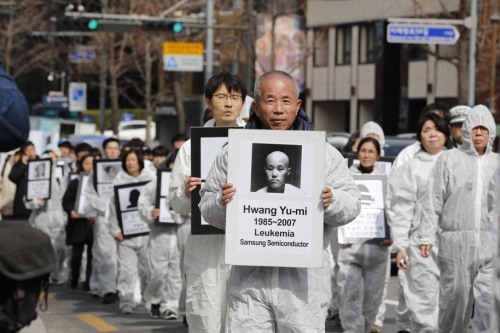
Hwang Sang-ki, 58 years old, began to take on Samsung six years ago, after losing her daughter Yumi to occupationally caused leukemia at the world’s largest tech company.

Six years ago, on March 6, 2007, Hwang Yumi died in her father’s taxi on her way to hospital. Yumi was only 23 years old. It was five years after she began to work as an operator at Samsung Electronics Co., Ltd. in the city of Suwan. And it was 20 months after she was diagnosed with acute myelogenous leukemia. The death of a daughter changed the life of her father. Since her death, Hwang Sang-ki, a taxi driver of modest means, did everything he could to get the tragic story of her daughter out in a country where the world’s largest semiconductor maker’s political and economic tentacles reach to every corner. Samsung attempted to suppress the father’s voice with hush money and blackmail.

His tenacity came to fruition in November 2007, when a group of public health and labor activists formed SHARPS. The independent news website Pressian interviewed Hwang on March 6 to mark the sixth anniversary of Yumi’s death. The following is a full English translation, with minor modifications to better suit English readers:

Six years after losing his daughter Hwang Yumi to Leukemia, Hwang Sang-ki still splits his time between Seoul and his hometown Sokcho. In the past six years, no rally against Samsung and its occupational disease cluster has taken place without his presence. “I am making a living driving a taxi in Sokcho. Splitting time between the two cities is really hectic,” Hwang told the reporter.

March 6th marks the sixth anniversary of Yumi’s death. The entire six years also represented the time he spent fighting to get his daughter’s death legally recognized as the result of occupational hazards. It took six years after her death–and four years after his court petition to win a lower court ruling that workers compensation for Yumi’s death should be granted—something Samsung has been denying and the Korea Workers Compensation & Welfare Service (KCOMWEL), the regulatory body, had been fighting.  This is not the end of the story. Hwang may spend more years in court as high court, and Supreme Court, proceedings are still ahead of him.

Blank Letter of Resignation    

It was June 2005 when Yumi was diagnosed with acute myelogenous leukemia. She was 21 years old. She developed the condition though there was no family history of the rare disease. It had been only 20 months after she began to work as an operator at the Kihung plant of Samsung.

In December 2005 when Yumi’s condition took a brief favorable turn after bone marrow transplants, Hwang learned of words that 30-year-old Yi Sook-young, a Samsung employee who worked alongside Yumi, died of leukemia. That confirmed his belief that her daughter’s disease was the result of occupational hazards. It was hardly a coincidence that the two co-workers developed the rare type of leukemia, which was found in only 4.2 out of the 100,000 people aged 20 to 29 nationally. Instead of approving her disease as an industrial accident, Samsung demanded Yumi’s resignation.

“Managers visited me at home in Sokcho.  They said Yumi must resign immediately because her sick leave could no longer be extended. They asked me if I had anything to ask of the employer before she resigns. I requested they petition for workers compensation for her so Yumi could get medical treatment without interruption. Then, a manager asked me, ‘Do you believe you can take on Samsung and defeat us?” I answered, ‘I can’t.”

“They told me to ask for something other than workers compensation. I asked them to pay for Yumi’s treatment. The manager demanded Yumi’s immediate resignation in exchange for KRW 50 million (U$4,610) They gave me a folded blank paper on which to put Yumi’s full name and national ID number. That became her letter of resignation”

In mid-November 2006, after the blank “letter of resignation”, Yumi’s condition grew worse.  The manager who picked up the resignation letter visited Hwang again, now with the KRW 50 million. He said the KRW 50 million was all he could offer and demanded that Hwang accept it.

Hwang began to look for former Samsung employees who had developed leukemia. By word of mouth, he found six victims. Meanwhile, Samsung maintained that Yumi, having resigned, had nothing with the company any longer.

“In January 2007, four human resources managers visited me at home again. I demanded the reason why they insisted Yumi was not an industrial accident victim—although she and six others developed the disease. Then, they said the company does not use chemicals or leukemia-causing materials. They demanded the reason why I was trying to frame Samsung with lies. The talk discontinued as the four managers cornered me. And Yumi was dying. They did not ask anything about her condition. I was so sad and broke down into tears.”

Seizing Newspapers

On March 6, 2007, Yumi died. Hwang in vain resorted to elected officials, broadcasters–and indeed every possible place and people he could think of– regarding the working conditions that led to Yumi’s death. Finally, in June 2007, Uri Suwon, a small local newspaper, ran a report on Yumi’s death based on the journal she kept while working at her plant. In the same month, aided by labor advocacy groups, Hwang filed a petition with KCOMWEL for workers compensation. It was not an easy process.

“When I handed out copies of the newspaper at the gate of the plant, security guards took them away from the workers as they entered the factory.  I put the copies in the newsstands at the Suwon train stations.  Soon, well-built plainclothes men collected them all.”

On Sept. 1, 2007, Samsung conducted an epidemiologic probe of the plant. Hwang said of the probe as a sham. The probe should have been conducted, unannounced. However, the company knew the schedule and had enough time to prepare for it. “My daughter said she worked in a poorly ventilated room that was not compartmentalized. By the time they conducted the investigation, the factory was well-ventilated and cool, and separate areas were installed,” said Hwang.

After the epidemiologic investigation, a Samsung manager promised him KRW 1 billion (U$922,000) on the condition that he would stop contacting labor advocacy groups and publicly talking about the death of her daughter.

“I believed they attempted to silence me with money. Samsung believed that I would stop taking issue with it after being paid. However, I wouldn’t. more and more victims began to come out. I already knew there were six more at least. I believe that there must be no more victims.”

Short Victory After Long Fight

After Hwang’s efforts, on Nov. 11, 2007, about 20 labor and civic groups banded together and formed SHARPS. More victims came out. In May 2009, two years after receiving the petition, KCOMWEL turned it down.

In Jan. 2010, Hwang and four other Samsung workers who developed leukemia and other types of blood disease joined forces to bring an administrative lawsuit against KCOMWEL for denying their earlier petitions. Samsung, named as a party liable to the defendant in the lawsuit, hired six lawyers from big law firms to argue the case. On June 23, 2011, the court ruled in favor of Yumi and two other victims. It took yet another four years to score a legal victory after KCOMWEL’s rejections.

Boosted by Hwang’s triumph, more victims came forward. According to SHARPS, as of date, 200 workers once employed in the electronics industry have stepped forward.  The organization had profiled 80 deceased workers.

“Samsung lied. When five victims came out, Samsung did not deny culpability. When that number came six, Samsung did not deny it either. An organization was formed. Two more came out, increasing the number to eight.  Samsung admitted that many. More came out. Samsung merely admitted as many.”

Feb. 2011, the ministry of employment and labor finally confirmed that carcinogenic materials such as benzene, formaldehyde, and arsenic trioxide, as well as ionizing radiation, were in use at Samsung and other semiconductor makers. In April and December of the same year, two former Samsung employees’ petitions for workers compensation claims were granted by KCOMWEL.  The two women respectively suffered breast cancer and aplastic anemia. In addition to Hwang’s victory, the two female workers’ cases were one of the greatest accomplishments by SHARPS.

Samsung By Numbers

Six years after the death of Hwang Yumi, this blog has put together some numbers to better show what takes for SHARPS and its supporters to take on Samsung:

1,934  

The number of workplace safety violations turned up South Korea’s ministry of employment and labor in a probe that followed the fatal chemical leaks of Jan. 28-29.

250,000,000

KRW250 million, or $2.3 million, was the amount of penalties levied on Samsung by the ministry over the chemical leaks that killed one contract workers and injured four others.

1

The Samsung Suwon plant, where the fatal leaks took place, had only one full-time safety officer.

2014

According to the March 3, 2013 The Financial Times, Samsung denies all claims of child labor in China and other illegal labor practices after being sued by three French human rights groups. The suit accuses Samsung of deceiving consumers by violating its own promises on ethical working conditions and of using child labor. Samsung admitted breaches of certain regulations as its Chinese contractors such as excessive working hours. The company promised to end this practice by the end of 2014.

181

The number of workers who SHAPRS has profiled that have developed various types of blood disorder while employed at Samsung or its subsidiaries as of Feb. 2013.

69

Out of the 181 injured workers, 69 have died as of Feb. 2013. 

19

The age of the youngest victim is 19. The female worker, known by her last name Choi outside SHARPS because her family does not want her identity released, died of a blood disorder in 1995, a year after she began to work at the Kihung plant.

46

The age of the oldest victim is 46. Yun Jae-hyon, a male, began to work at Samsung’s LCD plant in 1989 and died of brain tumors in 2007.

35/34

In total, 35 female and 34 male victims have died.

Put Human Life Above Money

Hwang’s tiny victory came after many twists and turns. “When I first attempted to get the story of my daughter out, journalists and lawmakers looked the other way. Many friends and relatives of mine attempted to stop me, saying I could not take on Samsung,” said the 58-year-old taxi driver, “and that made me feel really lonely.”  He got physically hurt by Samsung, too. When he mounted pickets and protests, the company’s security guards often yanked him off the grounds, roughly.

I was assaulted during the funeral procession for Lee yun-jeng, who died in May 2012 of brain tumors after six years with Samsung. When we attempted to hold a rally at Samsung’s corporate headquarters, security guards did not allow us to pass.  Tens of them surrounded me. They tripped me and threw me on the ground.  I could not walk normally for months.  Samsung did not even allow us to commiserate over the unjust death of its own employee in front of its headquarters.  Families of other victims share the same pain.”

He then criticized the ministry of employment and labor and KCOMWEL—the government agencies purported to protect workers that he believes instead shield the employer from employees’ challenges.

“When I petitioned for workers compensation, I said Yumi had worked on line 3 of bay 3. A KCOMWEL clerk said Yu worked only for three months putting stickers on products in bay 3, based on the company’s statement. I said Samsung was lying. Then the clerk abruptly got angry and yelled at me. He said Samsung would not lie just because a few employees had died.”

“The epidemiologic probe by the ministry of employment and labor was no different. It investigated less than 10 percent of about 800-900 chemicals used in chip making. Samsung refused to disclose other chemicals, citing trade secrets, and the government did not pursue further. Trade secrets must not be above the right to health. High-tech exists to better human life, so do trade secrets and money. However, what Samsung and KCOMWEL say the right to business is above human life.”

What is on his mind six years after he began to fight an undefeatable Samsung?

“I had been making a living driving a cab for more than 30 years before Yumi became ill. Even back then, I believed that workers were poorly treated by the government.  Nevertheless, I had never fought back.  I met many people when I petitioned for workers compensation. I came to know that there were many workers who were unfairly treated.  Workers need to become better off, and society needs to be safer. Those in power impose too heavy a burden on the workers.”

Hwang said workers compensation is a social safety net for those injured in industrial accidents. “Epidemiologic probes should be conducted, unannounced. Corporations should disclose which chemicals they use. Regulations should be revised so corporations, not workers who petition for insurance claims, need to prove the causality between working conditions and the disease that they cause. Speaking of the recent fatal chemical leaks at Samsung, he said, “The government sides with corporations. Corporations cover things up. These incidents are bound to repeat.”

“I promised myself that I would reveal what had caused her disease. Getting her condition acknowledged as an industrial accident was the first thing to do. Now that her case is approved as an accident by a lower court, the causes of other victims’ illnesses need disclosing.  I kept my promise to her, but not completely yet.”

“The issue of occupational disease is not limited to Samsung. [Hazardous] chemicals are used at automobile, shipbuilding and semiconductor factories, but they are poorly managed. There are many workers who developed cancer or other illnesses. To protect them institutionally, regulatory criteria for occupational diseases must be eased. Yumi’s memorial day is getting closer.  I will fight on until no workers become ill because of their jobs, and until they will be fully compensated for their illnesses once they become ill.”

hwang2

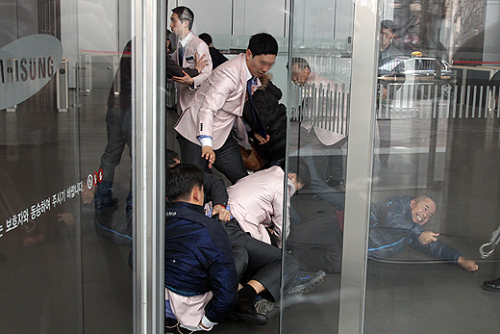
Samsung often responds to non-violent protests with excessive force. The picture was taken on March 9,. 2009 when SHARPS members demanded a meeting with Samsung executives.  Mr. Hwang (on the right in the picture) was thrown on to the floor.

<On Feb. 27, 2013, the South Korean police released CCTV footage of hydrofluoric acid gas leaks at Samsung.  The leaks, caused on Jan. 27-28 by gaskets that were in use beyond replacement time, killed one worker and injured four. >

The chronic safety negligence that led to chemical leaks, and ensuing cover-ups of the incidents that resulted in one death and four injuries, were not sufficiently serious for the South Korean government to pursue criminal charges against top executives at Samsung Electronics Co., Ltd.

On Feb. 27, the South Korean police said it would criminally charge seven individuals for negligence in the hydrofluoric acid leaks of Jan. 28-29 at a Samsung chip plant in Hwaseong, about 70 kilometers south of Seoul.

Among the seven individuals, a 34 years old contract worker identified by his last name of Park, died of exposure to the leaks. The other six include three employees of STI, Samsung’s contractor, and three mid-level managers of Samsung.

The negligence charges were indeed a slap on the wrist, given that the world’s largest semiconductor maker has been not only routinely violating safety regulations but also been aggressively covering up its run-ins with the law.

Following are new findings collected from the police’s announcement and media reports:

New Fact 1. Samsung Used Key Components Past Expiration Dates

The police pointed to the neglected seals and old gaskets of the gas tank as reasons for the first leak on Jan. 28. The gaskets had been used and reused past their scheduled replacement dates.

The second leak was preventable, according to the police, had new seals between the tank and the pipe been completed by the workers.

A simulation test by the police put the amount of leakages at a maximum of seven liters per hour during the first leak on Jan. 28. The government could not estimate the volume of the second leak for lack of data; a gauge collecting data of gas flows had been out of order.

Poorly maintained equipment and rushed repairs are commonplace at Samsung. Many occupational disease victims profiled by SHARPS said machines in a state of disrepair posed constant hazards.

New Fact 2. Samsung Released Fatal Gas Out Of Its Factory

The police confirmed earlier unattributed press reports that on Jan. 28, around 6:00am, Samsung and STI workers used huge ventilation fans to remove hydrofluoric acid leaks from the central chemical supply system, or the CCSS, where leaks took place.

Samsung has to date denied the fatal gas had filtrated through the CCSS.  A group of environmental volunteers found residue of hydrofluoric acid in the soil around the Hwaseong plant, which is ringed by housing compounds.

New Fact 3. Samsung Effectively Turned Off Sensor Alarm

According to the police, though the sensor in the CCSS was fully functional during the leaks, the volume of its alarm was reduced to inaudible levels. Samsung allowed STI employees to replace the corroded gaskets on Jan. 27 at 2:11pm, about four hours after the contract workers requested a replacement from a Samsung supervisor.

It wasn’t until 6:08pm, about 16 hours after the leak, when a Samsung security officer showed up at the CCSS.

On March 15, a multi-agency taskforce will announce its findings.


Image

About 26 hours after the first leak on Jan. 27, South Korean police began to investigate the site of Samsung’s Hwaseong plan where yet-undetermined amounts of hydrofluoric acid gas were released.

Neighboring elementary schools have postponed new semesters in fear of fallout from recent chemical leaks at a nearby Samsung plant.  The surrounding community is unsettled with anger and frustration.  However, nine days after leaks of hydrofluoric acid gas that killed one worker and injured four at its plant south of Seoul, Samsung Electronics Co., Ltd. continues to cover up the fatal incidents with more lies.  The following is a quick rundown of new facts that the world’s largest chipmaker had been covering up since this blog’s last post:

Fact 1

Samsung said of the Jan. 27-28 leaks as the first-of-its-kind incident.  However, it was not the first time that hydrofluoric acid gas, a virulent and deadly impurity remover for semiconductor wafers, has leaked at the Hwaseong plant.  The conservative Chosun Il bo quoted a study conducted in 2011 by Dr. Suh Byung-seong, of Sungkyunkwan University and Kangbuk Samsung Hospital, and reported that a 37-year-old male worker was treated in Sept. 2010 after exposures to the acid gas. 

Prof. Suh’s study did not name Samsung’s Hwaseong plant as the site of the leak and instead described it as a semiconductor plant with 20,000 employees.  However, Samsung confirmed the incident, saying “a contract worker was exposed to the leak [three years ago].”  This is particularly outrageous because while Samsung concealed the leak from authorities in breach of law, a professor who teaches at a university and a hospital that Samsung owns, could still conduct a study of the victim. 

Fact 2

Initial press reports put the volume of the January 28-29 leaks at ten liters.  Later, Samsung said it was about two or three liters.  However, an autopsy of the 34-year-old victim known by his last name Hwang turned up a blister larger than one centimeter in the respiratory path, suggesting that the amounts of the leaks exceeded the capacity of his gasmask’s filter.   The exact volume of the leaks has yet to be determined.

Fact 3

Samsung ordered the four workers who were dispatched to the leak from contractor STI Service to patch up the leaks with absorption pads and plastic bags although the workers reported that the melted gasket needed immediate replacement, according to an opposition lawmaker who interviewed one of the four workers. 

It was about 11:30pm, about nine hours after the first leak, when Samsung management agreed to the replacement. Hwang, who ultimately died due to his exposure to the leak, had to work on the leak during his first hours on the site without wearing a protective suit because Samsung had urged him to stop the leak immediately so production would not be interrupted. 

Image

A bird eye view of Samsung’s Hwaseong plant where hydrofluoric-acid leaks Jan. 28 killed one worker and injured four others. Samsung did not contact authorities for 26 hours after the chemical leaks although the plant is ringed largely with residential homes.

Samsung Electronics Co., Ltd. failed to contact authorities for 26 hours after two separate leaks of hydrofluoric acid gas killed one contractor and injured four others at its chip plant, about 70 kilometers south of Seoul, in Jan. 27-28.

Fatal Leaks

On Jan. 27, about at 1:00pm local time, a 500-liter (132 gallon) tank at Samsung’s Hwaseong, Gyeonggi-do plant began to leak diluted hydrofluoric acid gas through a melted gasket, the independent newspaper Hankyoreh reported.  The tank reportedly leaked again at 5am the following day.  A total of ten liters of the acidic gas leaked.

Hydrofluoric acid, used to remove impurities from chip wafers, is a potentially dangerous industrial-grade substance that can immediately and permanently damage lungs and corneas.

At 11pm, Samsung called four workers of maintenance firm STI to fix leak.  The world’s largest chipmaker did not report the leaks until 3pm, about an hour after an STI worker died from exposure to the acid and four others were hospitalized for chest pain and rashes.

Go Unreported And Unprotected

Contrary to earlier press reports claiming that the dead worker did not have any protective gear save a mask, the 34 years old, identified by his last name, Park, wore a protective suit after inspecting the leak, according to a Yonhap News report.   The other four’s protective suits proved inadequate, as they all were exposed to the gas and were hospitalized.  Over the course of about nine hours, the five contractors struggled to stop the leaks with plastic bags, and to remove the melted gasket.

Exemption

Samsung did not immediately report the leak to authorities, in breach of regulations.  However, the local government of the Gyeonggi-do province has exempted the company from a higher version of safety inspections. On a regular round of inspections of local factories less than three months ago, the government failed to inspect the gasket that leaked Jan. 27, Newsis News reported.

Risky Outsourcing

The leak accident revealed that Samsung has been outsourcing safety management to contractors, despite being heavily dependent on hazardous materials in chip production.   It also showed contract workers are more likely to be exposed to hazardous conditions.  Last year, after a series of revelations of excessive overtime and irregularities at its Chinese contractors, Samsung promised to improve working conditions across its supply chain.

However, harsh working conditions are not limited to its overseas contractors.   In October 2012, SHARPS profiled Kim Ki-cheol, 27 years old, who was diagnosed with acute leukemia after having worked as a contract wafer operator at the Hwaseong plant since 2006.

On SHARPS

As of March 2012, SHARPS has profiled 155 workers who contracted various forms of leukemia, multiple sclerosis, and aplastic anemia after employment in the electronics industry in South Korea.   As of June 2, 2012, 63 of the 155 have died.  The majority of the workers, 138, were employed at Samsung Electronics, Samsung Electro-Mechanics and Samsung SDS—the three electronics affiliates of the Samsung Group, the country’s largest conglomerate.  Among the 63 deaths were 56 Samsung employees.

Correction 1: The original version of this story said Samsung did not contact authorities during the first 15 hours after the leaks.  However, a Samsung spokesman on Jan. 28 evening said that the casket began to leak on Jan. 27 about at 11am.  The contract workers began to repair the leak at 11pm.    Samsung did not report the leaks for 26 hours after the leaks.   The post has been revised to reflect the correction.

Correction 2: The original version of this story cited a Herald News  report and said during its latest inspection of the Samsung plant four months ago, the government did not inspect the casket that leaked Jan. 28   However,  Newsis News cited  a government source and said the province government did not inspect the casket during inspections it performed of 28 plants in its jurisdiction on Oct. 11-17, 2012.  The post has been revised to reflect the correction.

Correction 3: The original version of this story cited several Korean press reports and said the dead maintenance worker did not wear a protective suit.  On Jan. 29, Samsung confirmed the 34-year-old known as Park actually wore a protective suit after protests by his family.  The post has been revised to reflect the correction.

Image

Photographs of Samsung’s occupational-disease victims were displayed at the entrance to a National Assembly hearing in Oct. 2012 (ohmynews.com).

After six years of campaigns and petitions over 56 occupational-disease deaths at the world’s largest chipmaker, SHARPS has agreed to enter dialogue with Samsung Electronics Co., Ltd. over the question of compensation for the victims of the company’s blood-disorder clusters and their families.

“Samsung’s dialogue proposal is the result of six years of our ceaseless efforts,” said SHARPS at a press conference January 22.

“Samsung has treated my daughter’s leukemia as though it was a random disease,” said Hwang Sang-ki, who lost her daughter Yumi to occupationally caused leukemia at Samsung.  “They also treated me like a heinous fraudster,” said the 58-year-old taxi driver whose lone outcry for her daughter’s untimely death six years ago led to the formation of SHARPS.

“Because the public has been scorning Samsung, thanks to our long campaign, the company agreed to dialogue,” Hwang concluded.

Ploys

This is not the first time Samsung sought out direct dialogue with SHARPS.  And to date, all proposals have come up with ploys.  In September 2012, through its lawyers, Samsung proposed to seek arbitration on an appeal lawsuit brought by SHARPS, on behalf of a leukemia victim’s family, against the Korea Labor Welfare Corporation, the South Korean government’s workers compensation entity.  SHARPS rejected the proposal because Samsung, a third party to the lawsuit, called for dropping the lawsuit.  In October 2012, Samsung leaked a false story to the media, claiming that it has begun dialogue with SHARPS.

It was November of last year when Samsung sent SHARPS a written request for dialogue through a lawyer representing the company in the appeal lawsuit.  In December, SHARPS accepted the proposal.  In January 2013, Samsung complied with SHARPS’s request and confirmed SHARPS’s acceptance in writing.

The following is the timeline:

March 6, 2007  Hwang Yumi, Samsung’s former chip line worker, died of leukemia.
Sept. 28, 2012  Samsung made its first request for dialogue with SHARPS, on the condition that SHARPS would drop the ongoing workers compensation lawsuit.  SHARPS rejected it.
Oct. 17, 2012  Some media outlets began to run false stories that Samsung had initiated dialogue with SHARPS.
Oct. 18, 2012  Testimony by Samsung executives at a National Assembly hearing confirmed that the aforementioned media reports are false.
Nov. 27, 2012  Choi Wu-su, president of Samsung’s device solution unit, sent a written request for dialogue through a lawyer representing Samsung at the workers’ comp lawsuit
Dec. 20, 2012  SHARPS accepted the request in a letter to Samsung Representative Director Kim Jong-jung.
Jan. 4,  2013  SHARPS in writing urged Samsung to express its willingness to dialogue in writing.
Jan. 11, 2013  Representative Director Kim notified SHARPS, in writing, of the formation of a negotiation team.

Maneuvering

In a letter dated January 11, Choi Wu-su, president of Samsung’s device solution unit, said the company tapped an in-house lawyer and a human resources executive for dialogue with SHARPS.

However, the company appears to be continuing its maneuvering by leaking unsubstantiated leads to the media.   On January 22, the independent Hankyoreh described a new remarkable proposal under consideration at Samsung for the occupational disease victims, citing an anonymous Samsung executive.  “If necessary, we can raise a special fund for the people who developed leukemia not just at Samsung but also anywhere at home and abroad,” the newspaper quoted the unnamed source as saying.

Over the past six years,  SHARPS has profiled 155 workers who contracted various forms of leukemia, multiple sclerosis, and aplastic anemia after employment in the South Korean electronics industry.  As of June 2012, 63 of the 155 have died.  The majority of the workers, 138, were employed at Samsung Electronics, Samsung Electro-Mechanics, and Samsung SDS—the three electronics affiliates of the Samsung Group, the country’s largest conglomerate.  Of the 63 deaths, 56 were Samsung employees.

Follow

Get every new post delivered to your Inbox.

Join 95 other followers